
“The clearest path toward truth”: An Interview with Melissa Faliveno
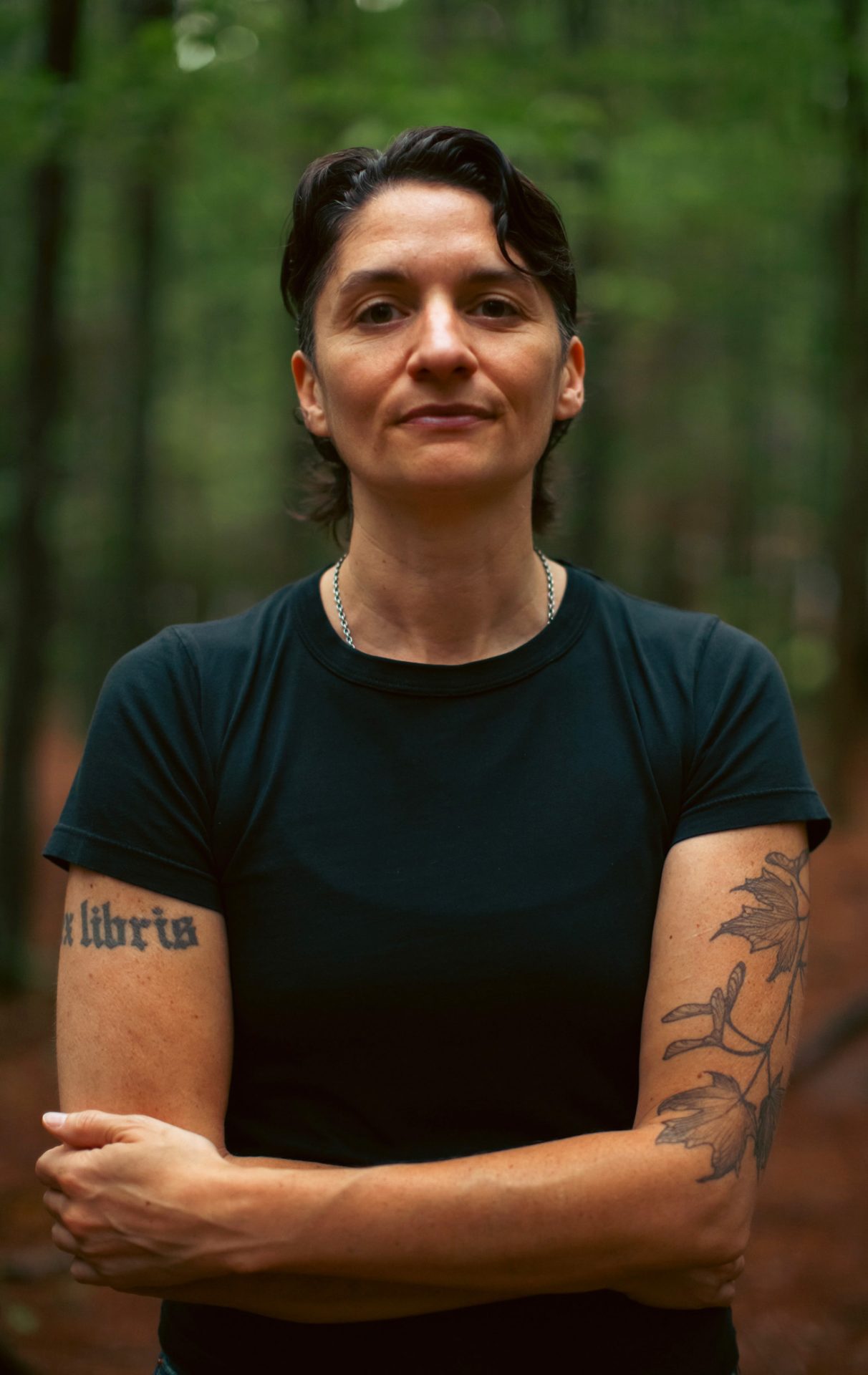
Melissa Faliveno is the author of the novel Hemlock and the essay collection Tomboyland, named a Best Book of 2020 by NPR, New York Public Library, Oprah Magazine, Electric Literature, and Debutiful, and recipient of a 2021 Award for Outstanding Literary Achievement from the Wisconsin Library Association. Her work, which has been nominated for a Pushcart Prize and received notable selection in Best American Essays, has appeared in Esquire, Paris Review, Kenyon Review, Literary Hub, Prairie Schooner, Brevity, and Brooklyn Rail, among others, and in the anthologies Sex and the Single Woman and Hit Repeat Until I Hate Music. The former senior editor of Poets & Writers Magazine, Melissa is an assistant professor of creative writing at the University of North Carolina and lives in the woods outside Chapel Hill. www.melissafaliveno.com
Melissa Faliveno, our 2026 Nonfiction Contest judge, is interviewed by Kt Amrine, our 2026 Nonfiction Editor and Hybrid Editor.
KT AMRINE: What non-writing related practice, routine, or love keeps you grounded to the Earth, your beloveds, and/or your community these days?
MELISSA FALIVENO: Taking walks in the woods, as often as possible. And taking my old sweet cat on walks outside. And bird watching. And phone calls with distant family and friends.
KT AMRINE: At AWP 2026, you appeared on a panel titled “Writing Long in the age of the Quick Take” where you mentioned “falling down the rabbit hole” as a strategy of finding the “why” in your essays; following your obsessions until you lead them somewhere you never expected. What rabbit hole(s) have you been down lately, related to a writing project or otherwise?
MELISSA FALIVENO: We love a rabbit hole! Lately, I’ve been writing essays rooted in the natural world, and specifically the landscapes around me in North Carolina, which is a part of the country I’m still really getting to know. So I’ve been reading about the forests here, and native wildflowers, and birds, and the mountains and the ocean. It’s been very fun.
KT AMRINE: You have written in both long and short nonfiction forms, from your essay “Carry Me” (published in Brevity) to “The Finger of God,” the first and (tied for) the longest essay in your collection Tomboyland at 40 pages. How do you decide how long or short an essay is? What do you see as the strengths/capacities of each?
MELISSA FALIVENO: Most of the time, an essay will tell me how long or short it wants, or needs, to be. If I’m doing a ton of research, or know I want to interview people for an essay, that’s a pretty clear sign that it will need to be longer. But since writing those long essays in Tomboyland I’ve been having a lot of fun experimenting with flash. They allow for strong imagery and lyricism, and can hold so much in such a small space—these little snapshots of life, like a poem. I think my next collection
will be a mix of longer and shorter essays, which feels exciting.
KT AMRINE: Earlier this year, you published your second book Hemlock, a novel. How has writing fiction informed or shaped your approach to nonfiction—or, vice versa—how did writing an essay collection shape your approach to writing a novel? Besides genre, how else are they different? How are they similar?
MELISSA FALIVENO: In writing Hemlock, I found that my processes of writing fiction and nonfiction are pretty similar. I’m a seek and find as I go kind of writer, and this novel really led the way in terms of character and story. I just kind of followed. The same is true of my essays—I let them take me. The differences in fiction, for me, exist in things like pacing and plot, and I had a lot of fun with character development and dialogue. As an essayist, fiction still feels pretty liberatory to me, but I find that at the end of the day, it’s still a form of truth-telling. In a strange way, this novel feels even more true than some of my essays.
KT AMRINE: In your essay “Switch-Hitter,” you describe memory as “transient,” saying “traces will come back to you now and again—with a faded photo, the smell of newly cut grass or spring rain, the way a certain summer light hits the midwestern sky just right. But much of it will leave you…we can work on digging such memories up, but these things have a way of working themselves to the surface all on their own. ”How would you describe your relationship to “truth” in nonfiction?How do you grapple with multiple realities, the unknown, and/or the transience of memory? What strategies do you employ to write something you have a hard time remembering?
MELISSA FALIVENO: The question of memory and truth is one of the things that propels me most as an essayist. I think of the fallibility of memory not as a limitation, but as a kind of liberation, and the clearest path toward truth. I tell my students this all the time. Naming that fallibility, the unreliability of our memories—the way it changes over time, or from one person to the next—is one of the most honest ways into a story, and writing into uncertainty is one of the places I feel the best essays
live. To do this, I love to do what some folks call “perhapsing,” and one of my favorite prompts for my CNF students is this: Using Jo Ann Beard’s flash essay “Maybe It Happened” as inspiration, write a short piece using words like “maybe,” “perhaps,” “it’s possible,” and “it’s likely” to work your way into a memory. Because of that transience, that unreliability of memory, in naming the uncertainty, we often find the truest version of a story.
KT AMRINE: In an interview with Electric Lit, you mentioned that you started writing Hemlock almost immediately after Tomboyland was finished, as a fun project you weren’t even sure was going to turn into a book. You also mention that you kept this quiet for a long time; that you “didn’t want to name it and have it not happen.” With that in mind, are there any projects you’re working on currently? And if you don’t feel comfortable naming them: do you think you’ll return to nonfiction for your next project, stay in the realm of fiction, or something entirely different?
MELISSA FALIVENO: I’m currently working on four new projects, which is a wild thing to say! Two of them are calling me most right now, so those are the two I’m following. And while I can’t tell you just yet exactly what they are, I will tell you that one is an essay collection and the other is a novel!
KT AMRINE: Lastly, what are you looking for in a Black Warrior Review Nonfiction Contest-winning piece?
MELISSA FALIVENO: I’m always looking for essays that take me somewhere. I’m a writer of place, and I want to be taken to the place of a story and immersed there. Every story happens somewhere—it could be a city, or the woods, a kitchen, a hospital room; it could be a body, a photo, an image, a moment. What is the site of the story? What holds and houses it? Make me feel it, see it, know it. Beyond that, I want essays that feel alive, a voice and a language that crackles on the page. I want sentences that force me to slow down and pay attention. I want prose that pulls me under, carries
me along. I rarely want an essay to try to teach me something; I want an essay to ask a question,to live in uncertainty, to try to figure its way out. What are you seeking? What are you trying to remember or know, what story or silence are you trying to say aloud? Ask those questions. Show me what you find.
Melissa Faliveno’s novel, Hemlock, came out in January 2026 from Little, Brown. To read more about her and her work, you can check out her website here. If you’d like to learn more about BWR’s 2026 contest, you can read the guidelines on our Submittable page, or check out our most recent contest issue, 51.2, by grabbing yourself a copy from our online store.